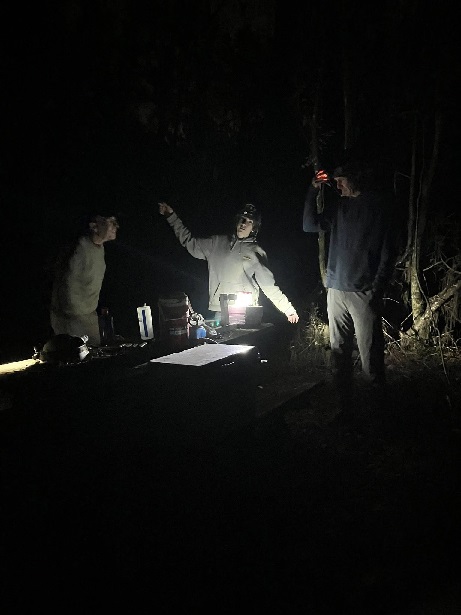
It’s science fair season! The kid and a couple of his goon friends decided to team up and skip the baking soda volcano and build a cloud chamber. Of course, a 12 year old saying “I’m going to build a cloud chamber” is on the same level as a 12 year old saying “I want a second dog and I promise to feed it, walk it, and take care of it”. As soon as you finish laughing, we’ll just accept the cloud chamber got built and move on with the tale.
I’m not going to go too much into what a cloud chamber is (the internet exists for a reason, you know) so we’ll just say it’s a device that allows you to see all the nifty products of our oddly radioactive universe… which in a roundabout way is how we ended up dragging a cloud chamber through our favorite local cave on the evening of January 10th, 2026 with lovely lab assistants Philip Walker and David Studard.
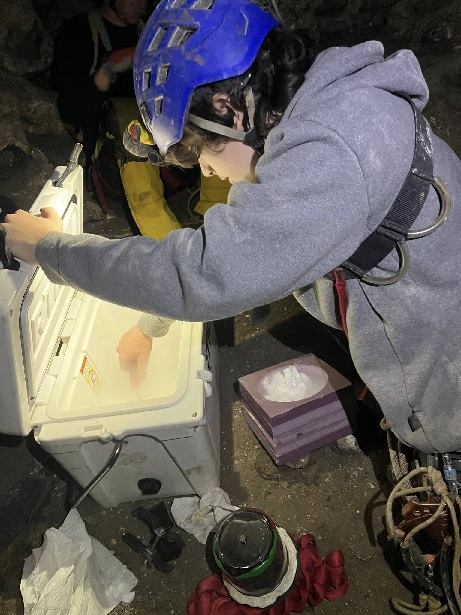
The original project was to see if a cloud chamber could be used to see radioactive emissions from various nouns. During the planning stages we had a conversation about the nature of science fair projects and what makes a project unique, engaging science. I opined that it wasn’t going to be easy to do something truly new, so interesting science would be an experiment that was very specific to the place you live or something specific to your interests. The kid wondered if it would be possible to take the chamber into a cave to see what the differences would be compared to the surface. This wasn’t going to be easy. A cloud chamber requires dry ice and a stable setup. To make it even trickier, we decided the best place for the experiment was our favorite multi-mile local cave.
A quick check with the preserve manager later and planning began in earnest. This cave was interesting as a location because it has several levels including one right up at the contact with the Hawthorn formation, which is a phosphatic clay layer which are often measurably radioactive. The project was going to be in parallel with the original experiment because among the many difficulties likely to be overcome we didn’t think we would be able to drag the kid’s friends through the ropes. That meant we could move right on to solving problem number 1A: how to get dry ice into the cave, and 1B: how to not damage the cave dragging dry ice into the cave. In the end we channeled our inner spelunkers and went for a two cooler setup, pretending we were just dragging crummy domestic beer into the cave.
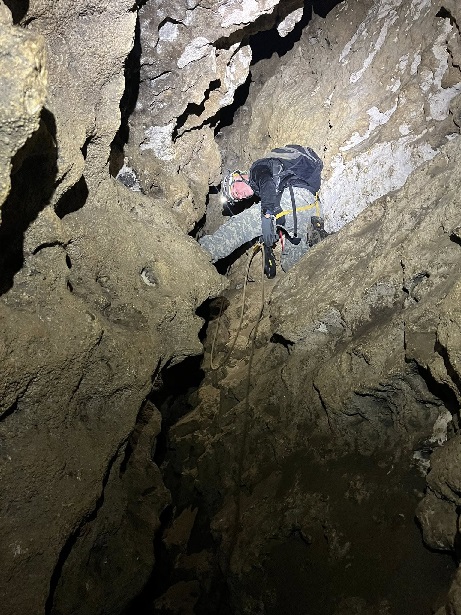
In all my years of designing experiments involving radiation and dry ice in caves this is the first, so a great deal of the plan we had to make up on the spot. Luckily we had Phil and Dave sign on for the trip meaning we had some good minds to bounce around ideas and work through the problems one by one. The first experiment run took place in the Crossroads, so we only had to get the larger cooler down the first drop. That was completed fairly easily so it was on to problem 2: how to get the dry ice up the second rope, which was a bit trickier with its rebelay and chimney up top.
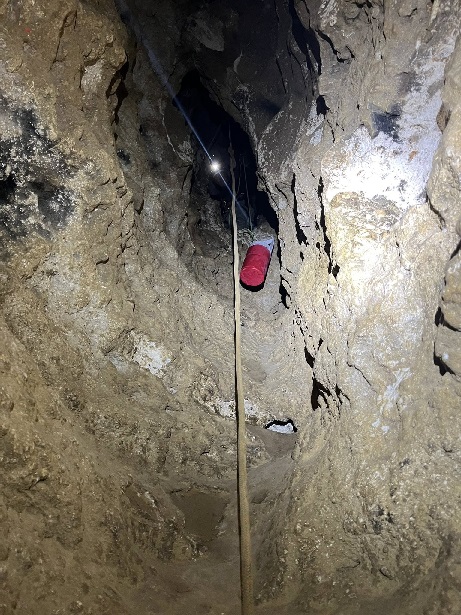
The answer was the second, smaller cooler. It only had to carry enough dry ice for the second experiment, so it could be a nice, compact round unit that could be pulled up by one caver and guided by another below. This task completed we were on to problem 3: the Cashew Squeeze, for which the small, round cooler was also the solution.
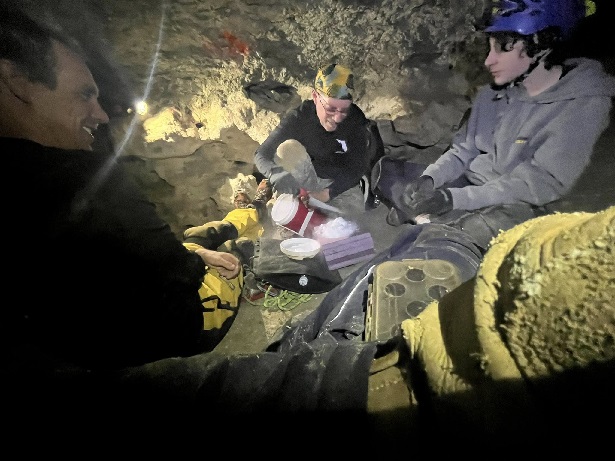
Into the Left Branch we bucket brigaded the various bits of kit up the climb to the upper level and quickly found an ideal spot for the experiment. By this point we were getting to be a well drilled team and the preparations went nice and smoothly.
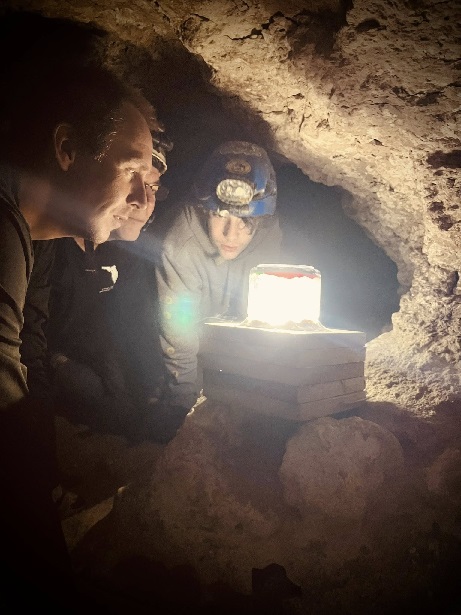
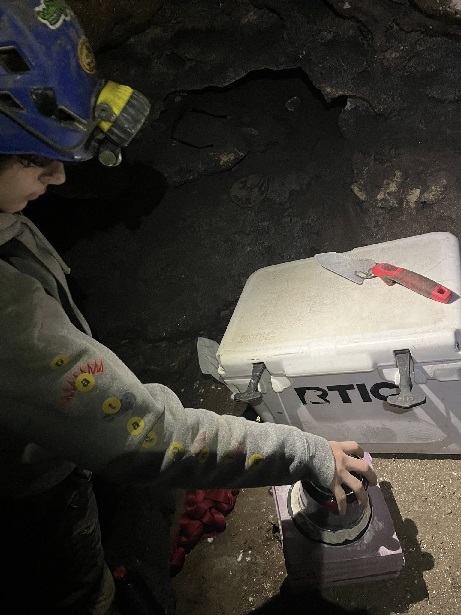
The rig we used had been designed specifically for this part of the project, but it had proven to be simple and controllable, so we had actually used it for the other part of the project with the other students even though it was in a more controlled environment. The upshot of this was that by the time we got into the cave there had been a lot of troubleshooting of the setup and it was easy to see what was going on inside the chamber. Phil and Dave had never seen a cloud chamber in operation (not that I was some sort of expert on the things), so it was nice that they got to work with the refined version. They quickly became skilled lab technicians, actively participating in the setup and running of the experiment rather than just helping to carry supplies. I will point out here that I will never cease to be surprised at how amazing cavers are. There’s something in the mind of a caver that seems to enjoy problem solving and teamwork, which are as important to science projects as to organizing a caving trip.
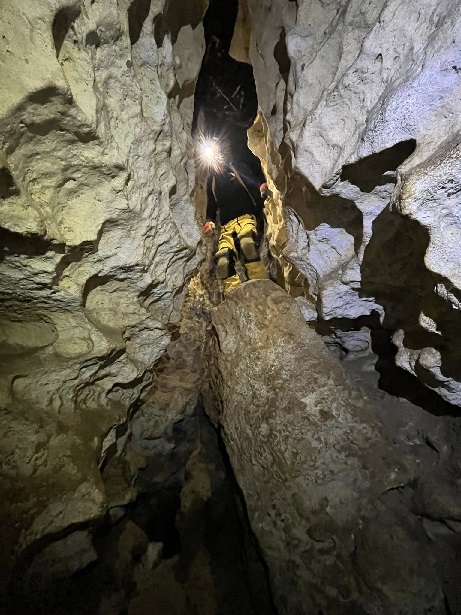
The upper level experiment concluded we still needed to conduct a control at the surface which we unscientifically performed last because we wanted to wait until it was completely dark outside. So with science completed for a moment it was time for another type of exploration. Dave (gasp!) had never been into this cave before. Despite being a very experienced caver of many years he had just never been in here. Those of you who know me will be aware that this is my favorite cave so there’s no way this situation could be allowed to stand. Before headed out we had to take Dave on what I refer to as the Phil Walker “ease em into it” Tour of the front of the cave up to the start of the Red Streak. I think this was successful at selling the cave and can’t wait to get Dave back in there to push further in.
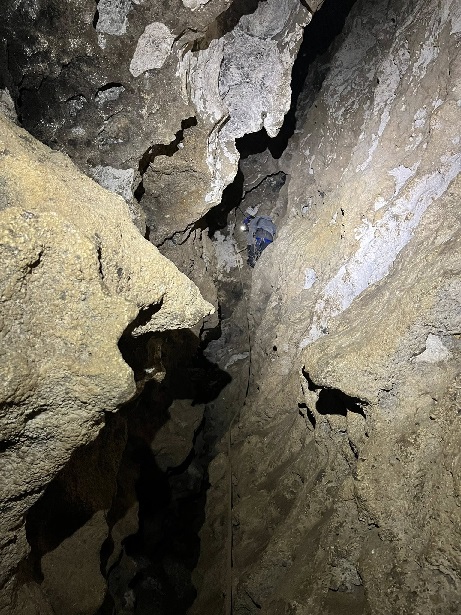
Tourist part of the trip complete it was on to problem 4: getting all the crap back out of the cave. The easy part was getting the setup, chamber and small dry ice cooler back to the crossroads. We were still working on the plan to get everything up the first drop, including the larger main cooler, but we were pretty sure we could overcome that as well. We still had to be gentle with everything because we needed to run the experiment one final time on the surface.
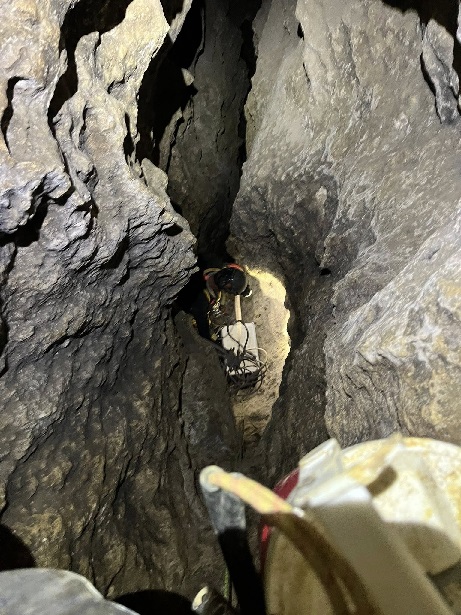
In the end we made use of the ropes we had on hand and Dave rigged up a sorta quick and dirty tyrolean to guide the cooler and keep it off the walls. We did the operation in two stages, getting it up to surprise ledge, resetting, then finishing it out to the lip.
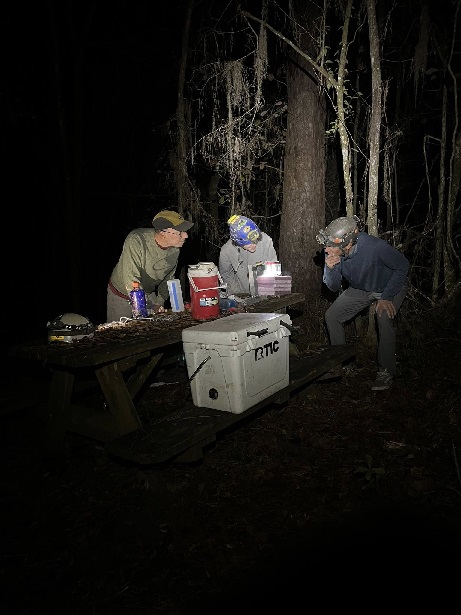
Up top we quickly ran through the control experiment but with a good bit of the dry ice left over we were able to conduct a few bonus experiments like “what happens if you pour water on dry ice” and “did you just spit on the dry ice?” Before packing up and conducting one final experiment “what should I get at Waffle House?” This last experiment was so amazing we were even able to involve FSS president Fletcher, who was fresh out of a city council meeting but couldn’t avoid the draw of the science of hashbrowns.

Two minute observation of the chamber in the upper level of the Left Branch. There are some tracks that are caused by cosmic radiation capable of passing through the earth, but most tracks are beta particles from the Hawthorn.
A great evening for a good cause…science. Story and Photos by Scott Thompson